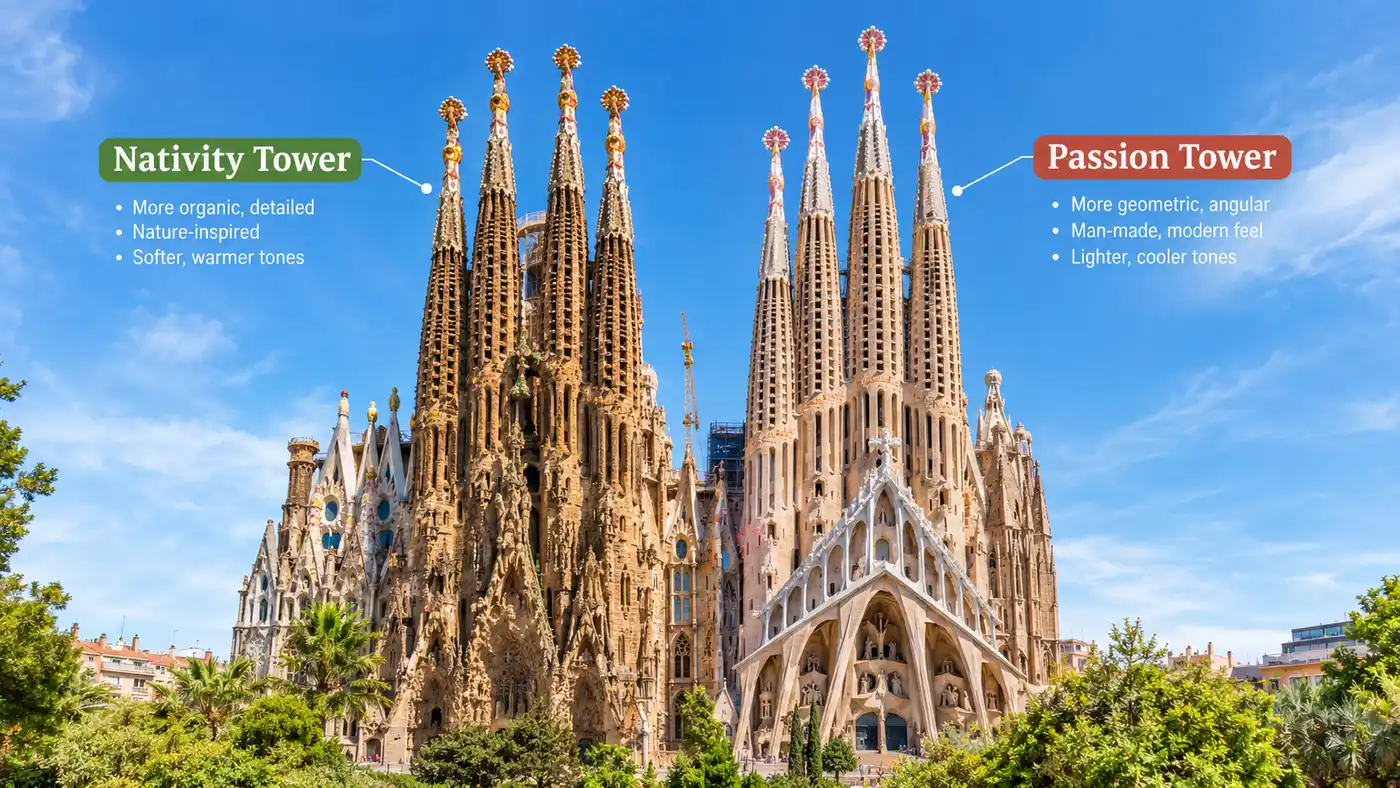
Sagrada Familia Towers: Nativity vs Passion Tower Comparison
You stand inside the nave, staring up at tree-trunk columns branching into stone canopies, and your neck already aches. Then you remember your ticket includes elevator access to the sagrada familia towers, which means you still have to climb out into the sky. Most visitors stand in the ticket line or stare at their booking screen frozen on one specific choice: Nativity or Passion? You can only pick one when you buy a standard tower ticket, and swapping your time slot or facade on the day of your visit is basically impossible.
Both spires jut more than 60 meters above Barcelona's rooftops, offering vantage points you cannot get from Park Güell or Montjuïc. Yet they feel like parts of two different cathedrals built centuries apart. One was touched directly by Antoni Gaudí before a tram took his life in 1926. The other feels stark, modern, angular, and slightly forbidding. Here is how they stack up, how the trek back down feels on your calves, and how to decide which tower matches the way you like to see cities.
Book your sagrada familia experience:
Sagrada Familia Towers: Nativity vs Passion at a Glance
Choosing between the towers feels high-stakes when tickets cost around 36 euros and sell out weeks in advance. The elevator shoots you up in roughly thirty seconds. After that, your feet do the rest of the work. You cross a narrow exterior stone bridge linking twin spires, peer through decorative stone carvings, and spiral down hundreds of tightly coiled stairs.
The eastern side belongs to the Nativity facade, looking toward the Mediterranean and the older, denser parts of Barcelona. The western side crowns the Passion facade, facing the city center, Montjuïc hill, and the setting sun. The architectural philosophy shifts between them just as sharply as the compass points.
| Feature | Nativity Tower | Passion Tower |
|---|---|---|
| Elevation reached by lift | 65 meters | 75 meters |
| Direction faced | East (Sea, Glòries, sunrise) | West (Eixample grid, Montjuïc, sunset) |
| Stairs to walk down | Around 396 steps | Around 404 steps |
| Gaudí personal involvement | Direct supervision during his lifetime | Built decades after his death |
| Bridge walk experience | Enclosed stone bridge among carved fruits | Narrow walkway with expansive urban views |
| Best lighting conditions | Morning hours (9:00 AM to 11:30 AM) | Late afternoon (3:30 PM to 5:30 PM) |
If you want authentic Gaudí heritage down to the mortar, the Nativity side wins without question. If sheer height, city-grid panoramas, and dramatic skeletal stone frames appeal to you, the Passion side holds the advantage.
Nativity Tower Sagrada Familia: The Gaudí Original
The Nativity tower sagrada familia experience drops you right inside the master's head. Antoni Gaudí lived on the construction site for the final twelve years of his life, obsessing over every detail of this facade. When the elevator doors slide open 65 meters up, the air hits you immediately. You step out onto a small covered platform suspended between two of the four spires. It feels tight. You share the ledge with maybe five or six other travelers, everyone leaning over stone balustrades to spot the glazed ceramic fruits crowning the smaller pinnacles nearby.
From this height, the details Gaudí planned for birds and angels become visible to human eyes. You get close looks at brightly colored mosaics made from broken Venetian glass and ceramic tiles. Down below, the eastern neighborhoods of Barcelona stretch toward the blue strip of the Mediterranean. The Torre Glòries cucumber-shaped tower reflects sunlight off in the middle distance. Construction cranes swing overhead, because the great central Jesus Christ tower is rising right next to your vantage point, giving you an intimate look at stonemasons and ironworkers doing active masonry work.
Pro tip: Book a morning slot between 9:00 AM and 10:30 AM for the Nativity tower so the rising sun behind you lights up the city and illuminates the colorful ceramic wheat bundles on the spires without blinding glare.
Walking the stone bridge between the towers feels dizzying. The bridge has solid stone walls up to your ribs, but the open slits let the wind roar through with real force on breezy days. Looking straight down from the walkway, you see the intricate forest of carved stone figures portraying Christ's birth, shepherds, and stone turtles bearing the weight of massive columns. For travelers diving deep into Gaudí's symbolism, our detailed facades guide breaks down the complex meaning behind every carved critter and vine visible from this angle.
The descent starts quickly after the bridge. A dark, winding corridor opens into the top of the outer spire, and then the stairs take over. It feels ancient, dusty, and wonderfully historic.
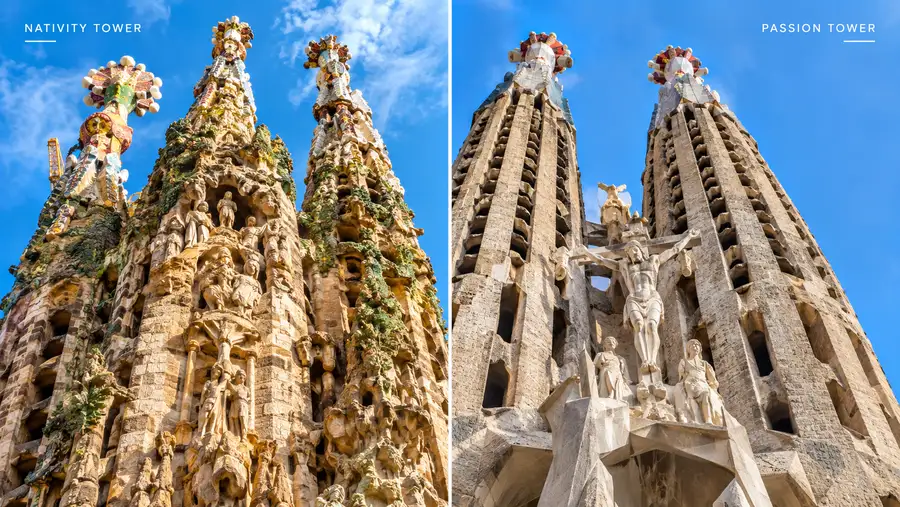
Passion Tower Sagrada Familia: Drama, Heights, and City Views
The passion tower sagrada familia offers a noticeably different vibe. While the Nativity feels like an overgrown stone forest, the Passion facade was designed to shock viewers into silence. Work on these western towers began in 1954 and finished in the mid-1970s, based on Gaudí's surviving sketches after anarchists destroyed his original workshop models during the Spanish Civil War.
The lift drops you slightly higher than the Nativity elevator, around 75 meters above the paving stones of Carrer de Sardenya. The view from passion tower sagrada familia is wider, cleaner, and looks out across the famous octagonal city blocks of the Eixample district. You trace the broad avenues cutting toward Plaça de Catalunya, the telecommunications spire of Montjuïc, and the green ridges of Tibidabo mountain behind the city.
Photographers often prefer the passion tower sagrada familia view because the visual field feels less obstructed by neighboring masonry. The stone bridge linking the Passion spires gives you a direct sightline toward the setting sun, making afternoon slots feel golden and warm. You also get clear views of the angular, bone-like sculptures carved by Josep Maria Subirachs. His tortured, hollow-eyed figures represent the arrest, trial, and crucifixion of Christ. Seeing these jagged, modern statues from above reveals how their sharp angles contrast deliberately with the smooth, organic curves of Gaudí's earlier work.
Note: Lockers at the base of both tower entrances are mandatory for backpacks, tripods, and bulky day bags; you need a 1-euro coin or a small token to release the lock, though the coin is returned when you retrieve your gear.
The descent on the Passion side is just as steep, but the light wells feel slightly larger in spots, giving you rhythmic glimpses of the city grid every few turns of your feet.
Book your sagrada familia experience:
Climbing Down: Sagrada Familia Towers Stairs and Safety
Nobody takes an elevator down from the towers. The elevators only move up, which means every visitor who ascends must walk down approximately 400 stone steps. If you have bad joints, balance troubles, or genuine panic around enclosed heights, this is where you need to be realistic about your limits.
The descent winds through the interior core of a hollow spire. The design mimics the internal shell of a marine snail. There is no central support pole for the lower half of the descent. Instead, you stare down a corkscrew opening straight into an empty stone void that drops hundreds of feet. A sturdy metal handrail lines the outer wall, bolted firmly into the masonry, and the steps are wide enough for one person at a time. Overtaking someone is awkward, so everyone moves at the pace of the slowest person in the group.
Here is what you should consider before committing to the sagrada familia towers stairs:
- Vertigo and heights: looking down the center of the hollow snail-shell staircase will make your stomach drop if you get dizzy around steep edges.
- Knee and ankle wear: walking down 400 continuous spiral steps on solid stone requires constant quad braking, which burns your thighs if you rarely climb stairs.
- Claustrophobia triggers: certain sections narrow dramatically, with rough stone walls brushing both shoulders and very little natural airflow on hot July afternoons.
- Age restrictions: children under six years old are strictly barred from the towers by safety staff, and kids up to 16 must stay within arm's reach of an adult.
Halfway down, tiny arched openings cut into the perimeter wall let fresh breezes rush inside. These slit windows give you unique vantage points to catch your breath, let the person behind you pause without feeling rushed, and snap close-up photos of the cathedral's ornate drainage spouts and geometric finials.
Sagrada Familia Tower Tickets and Timing: Are the Sagrada Familia Towers Worth It?
A basic general entry ticket to the basilica floor runs around 26 euros, while adding tower access bumps the price to roughly 36 to 40 euros depending on whether you pick an audio guide or human guide package. That extra ten to fourteen euros raises a fair question: are the sagrada familia towers worth it?
If you only care about seeing Barcelona from high up, the tower might disappoint you compared to the open 360-degree panorama from the top of the Montjuïc cable car or the roof terrace of the MNAC museum. The tower bridges are small, the views are framed through stone openings, and guards urge you to keep walking so crowds do not stall on the bridge.
However, the value is not just the skyline. The value is inspecting Gaudí's bizarre architectural playground up close. You see the bizarre geometric textures, the ceramic mosaic details, and the sheer scale of the stone blocks that you cannot appreciate from the floor of the nave. When deciding on booking your tickets, picking a tower time roughly 45 to 60 minutes after your main entry time gives you ample breathing room to explore the forest-like interior without watching your watch every two minutes.
To squeeze the best experience out of your visit towers sagrada familia session, keep these practical points in mind:
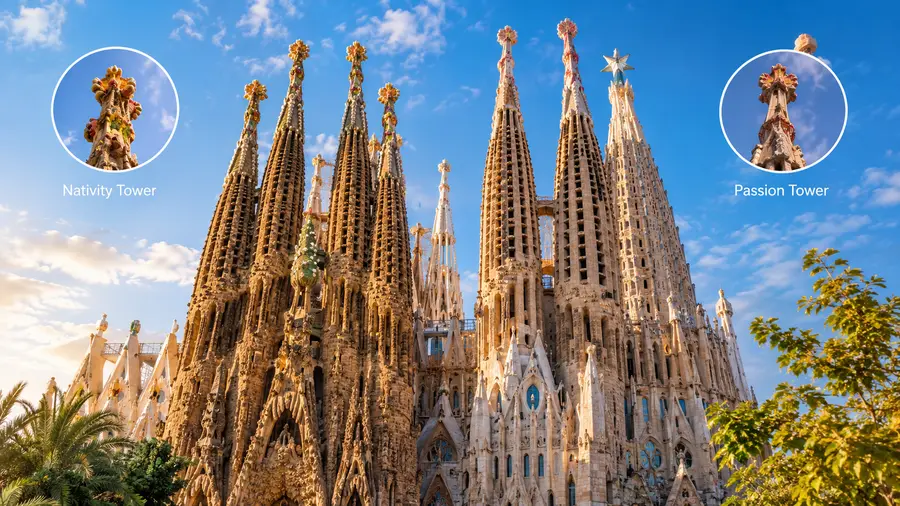
- Pick the Nativity tower if: you care deeply about seeing Antoni Gaudí's original handiwork, want morning ocean views, and love intricate organic stonework.
- Pick the Passion tower if: you want a higher perspective over the geometric streets of Barcelona, visit in the late afternoon, or prefer modern sculpture.
- Check weather forecasts: strong winds, torrential rain, or heavy electrical storms will shut down the elevators for safety, turning tower tickets into basic floor-entry passes with a refund process for the tower portion.
- Travel light: since your bags must go in the ground-floor lockers before the elevator ride, bring only your phone or camera with a wrist strap to keep both hands free on the stairs.
If you happen to be visiting on a quiet Tuesday morning in November, the experience feels peaceful and contemplative. On a boiling Friday afternoon in August, the stairwell can feel warm, slightly muggy, and crowded. Timing your season and hour changes everything.
Frequently Asked Questions about sagrada familia towers
Which sagrada familia tower is best for first-time visitors?
The Nativity Tower is generally considered the best choice for first-time travelers because Antoni Gaudí directly oversaw its construction before his death. Its bridge offers close views of the intricate stone carvings and colorful ceramic fruits that define his signature style.
Can you take an elevator back down from the towers?
No, the elevators only take visitors up to the walkway bridges. Everyone must walk down the 400 stone steps of the spiral staircase, with rare exceptions made by church staff for sudden medical emergencies.
Is the Nativity or Passion tower better for photography?
The Passion Tower usually produces better wide-angle photos of Barcelona's urban grid and Montjuïc, especially in late afternoon light. The Nativity Tower is superior for close-up shots of Gaudí's masonry, mosaics, and morning coastal lighting.
Are the sagrada familia towers worth it if you have vertigo?
Probably not. The descent features a hollow spiral staircase where you can look straight down through the center of the spire to the floor far below, which frequently triggers vertigo or anxiety in sensitive travelers.
Can children visit the towers at Sagrada Familia?
Children under the age of six are not permitted in the towers under any circumstances for safety reasons. Visitors aged 6 to 16 must be accompanied by a ticketed adult throughout the ascent and stair descent.
Quick Reference
- Nativity tower: 65m high, built during Gaudí's life, best in morning.
- Passion tower: 75m high, modern construction, best city skyline views.
- Descent: ~400 steps on foot through narrow spiral staircase.
- Price difference: roughly €10 to €14 more than general admission.
- Restrictions: no kids under 6, mandatory bag lockers at ground level.
Book your sagrada familia experience:
The Bottom Line: Which Tower Should You Pick?
If you force me to pick one spire, I tell friends to pick the Nativity tower every single time. Standing among the carvings Gaudí inspected with his own eyes carries a weight you simply do not feel on the Passion side. There is something grounding about walking past stone leaves, lizards, and nesting birds while smelling the sea breeze off the coast. Book your tickets four to six weeks early, empty your pockets into the ground-floor lockers, hold tight to the handrail on the descent, and give your calves a good stretch once your feet hit the basilica floor again.
Read more about sagrada familia.