Sagrada Familia Facades: Nativity, Passion & Glory Explained
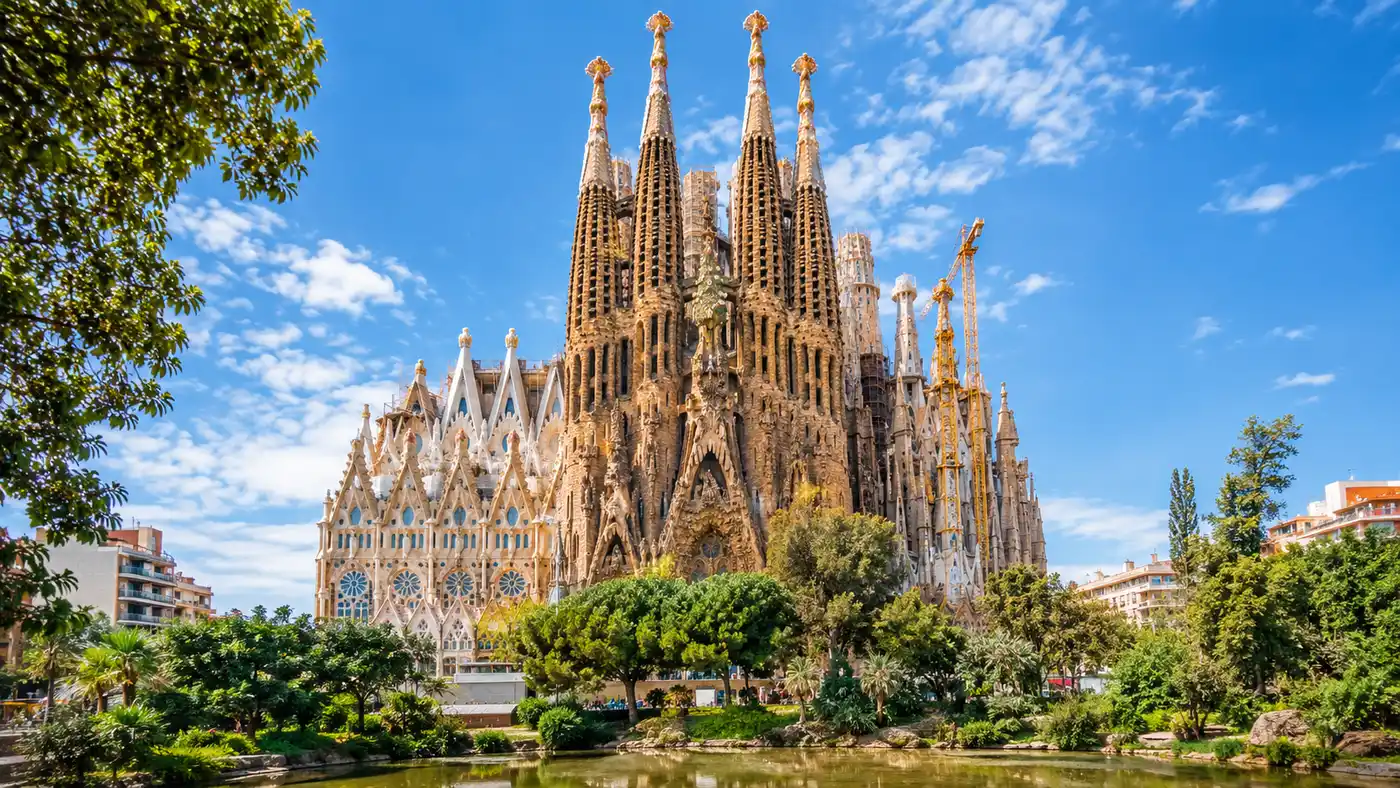
If you stand across the duck pond in Plaça de Gaudí around eight in the morning, the stone looks like it melted under a blowtorch and then froze mid-drip. Walk around to the opposite side twenty minutes later, and suddenly you are staring at an angular, bleached ribcage that belongs in a modernist war memorial. Most visitors think they are looking at one cohesive cathedral. What you are actually seeing is a decades-long argument carved in sandstone, granite, and concrete, split across three wildly distinct sagrada familia facades.
Antoni Gaudí knew he would never live to finish this church. When a tram hit him on Gran Via back in 1926, only a fraction of the structure stood above ground. He deliberately left drastically different blueprints for each side, anticipating that future architects would bring their own generational sensibilities to the work. Understanding how those three faces fit together changes the entire visit. You stop staring at a chaotic mass of pinnacles and start reading the building like an open book.
Book your sagrada familia experience:
Nativity Facade: Gaudí’s Stone Forest
The eastern front is the only part Gaudí saw near completion with his own eyes. Work started here in 1893 because he feared that if he began with the somber Passion front, the public would revolt and funding would dry up. He wanted something joyful first. The result is the nativity facade sagrada familia barcelona visitors photograph most often, an overwhelming celebration of life, birth, and nature.
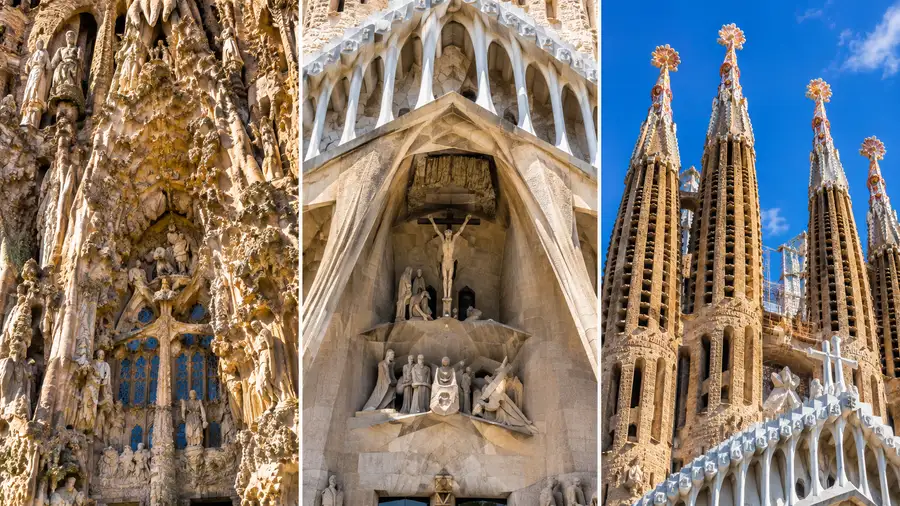
Looking closely at the sagrada familia exterior here feels like peering into an overgrown tide pool. Gaudí despised straight lines because he claimed they did not exist in God's nature. Instead, you get three massive porticos dedicated to Hope, Faith, and Charity, all encrusted with local Catalan wildlife. At the base of the two central columns, two giant stone reptiles bear the load. One is a sea turtle facing the Mediterranean, the other a land tortoise facing the Collserola hills. They symbolize stability and the slow passage of time. Higher up, salamanders crawl out of masonry crevices, while clusters of stone ivy look soft enough to rustle in the breeze.
Pro tip: Bring small pocket binoculars or use your phone camera's telephoto zoom, because the finest details sit thirty meters above eye level where human eyes blur them into background texture.
The human figures tell a much stranger story. To sculpt the sagrada familia statues across this wall, Gaudí made plaster casts directly from living people in the neighborhood. He cast church workers, local plasterers, and even sick infants at the nearby hospital to capture authentic bone structure and facial strain. When you look up at the Massacre of the Innocents on the left portico, the terror on those stone faces is disturbing because it belonged to real Barcelona families from the late nineteenth century.
Capping the central portal is a green cypress tree carved from stone, painted in quiet greens and flecked with white alabaster doves. It represents eternal life. Under the morning light, when the sun bounces off the Mediterranean and hits this facade directly, the shadows move across the stone like leaves shifting on a forest floor. It took roughly forty years to finish this side, and UNESCO added it to the World Heritage list for good reason. It is pure, unfiltered Catalan Modernism at its peak.
Passion Facade: Raw Bone, Anguish, and Josep Maria Subirachs
Walk around to the western side on Carrer de Sardenya, and the warmth evaporates. The passion facade sagrada familia shows the crucifixion and death of Jesus, and Gaudí wanted it to terrify people. He left sketches showing harsh geometric pillars that looked like taut muscles and fractured bones. He wanted no soft botanical carvings here. No birds. No vines.
Construction on this face did not begin until 1954, decades after Gaudí died. In 1987, the church trustees hired a controversial Catalan sculptor named Josep Maria Subirachs to carve the figures. Subirachs was a staunch abstract expressionist. Instead of copying Gaudí's flowing, organic style, he carved rigid, hollow-eyed figures with blocky jawlines and deep chisel marks. When the scaffoldings came down, locals protested in the streets. People hated it. They felt it desecrated Gaudí's vision.
Note: Keep in mind that morning light leaves this facade in deep, gloomy shade, which suits the subject matter, but you will get far clearer photos after three in the afternoon when the sun swings west.
Spend five minutes in front of it today, though, and the brutalism makes complete emotional sense. The narrative moves in an S-shaped path across three levels, starting from the Last Supper at the bottom left and climbing up toward the burial and resurrection. The central figure of Christ scourged at the pillar is tied to an off-center column, his face dropped in exhaustion. Subirachs left a hidden homage here too: the Roman soldiers wearing curved helmets are modeled directly on the surreal chimney pots Gaudí built on the roof of Casa Milà up on Passeig de Gràcia.
To the left of the Kiss of Judas sits the famous sagrada familia magic square. It looks like a standard four-by-four grid of numbers, but every single line, row, diagonal, and four-corner grouping adds up to 33, the age of Christ at his death. There are over 310 different number combinations that yield 33 on that small grid. If you look at the towering sagrada familia cross perched high between the belfries on this side, it stands stripped and bare, echoing the sheer desolation of the scene below. If you are trying to decide which elevator to book inside, comparing these viewpoints in our tower comparison guide will help you pick between the heights of these two worlds.
Glory Facade: The Massive Future Main Entrance
The south side facing Carrer de Mallorca is the sagrada familia facade glory, and right now it looks mostly like scaffolding, exposed rebar, and yellow construction cranes. When finished, this will be the principal entrance to the entire basilica. It is designed to be the largest, tallest, and most theatrical of all three fronts.
The theme here is human destiny. Gaudí planned a colossal composition detailing death, final judgment, the horrors of hell, and the ascent into celestial glory. Seven monumental columns will support the porch, symbolizing the seven gifts of the Holy Spirit. Below them, bizarre sculptural groups will represent the seven deadly sins, balanced by virtues on the opposite pedestals. It is medieval theology filtered through turn-of-the-century madness.
There is real drama happening on street level right now because of the sagrada familia stairway controversy. Gaudí’s original sketches call for an enormous elevated pedestrian staircase that extends south over Carrer de Mallorca, leading visitors straight into the main doors. Building that monumental walkway requires knocking down a block of residential apartments, potentially displacing around 3,000 residents who live across the street. Neighborhood associations have fought the board of works in court for years. It remains one of the most heated urban planning battles in Catalonia, and you can track how this affects the projected completion date timeline.
Even unfinished, you can walk up to the temporary construction hoardings on Mallorca street and examine the central bronze doors. Sculpted by Subirachs before his death, these massive portals are inscribed with the Lord’s Prayer in fifty different languages. The Catalan phrase for "Give us this day our daily bread" is picked out in raised bronze right next to where the door handles sit. People reach out and touch it through the metal barrier so often that the letters shine like gold.
Book your sagrada familia experience:
Comparing the Three Facades: Key Architectural Differences
Seeing all three sides on the same morning can feel disorienting. The materials change, the stone ages differently, and the artistic philosophies clash openly. Gaudí planned that tension intentionally. He compared the church to human skin, showing different expressions depending on where the world touched it.
| Facade | Orientation | Dominant Style | Primary Era | Key Emotional Tone |
|---|---|---|---|---|
| Nativity | East (Sunrise) | Organic Catalan Modernism | 1893 - 1936 | Joyful, lush, celebratory |
| Passion | West (Sunset) | Expressionist, Angular Brutalism | 1954 - 2018 | Austere, mournful, bone-dry |
| Glory | South (Midday) | Monumental Contemporary | 2002 - Present | Triumphant, dramatic, imposing |
The architecture of the church shifts underneath you as you walk the perimeter. Here are several specific sculptural details you should pause to locate as you move around:
- The pelican of self-sacrifice: Look directly above the central Nativity doorway to spot a stone pelican opening its own breast to feed its chicks, an ancient Christian symbol for communion.
- The veiled face of Saint Veronica: On the Passion side, Veronica holds out the cloth bearing Jesus's face, but Subirachs sculpted her with no face of her own, a terrifying blank cavity.
- The evangelist symbols: The upper towers feature colossal stone attributes of the four gospel writers, including an angel, an ox, a lion, and an eagle, sculpted with razor-sharp geometric planes.
- The bronze prayer door: On the Glory side, find the Catalan words "El nostre pa de cada dia" among fifty world languages, cast directly into solid metal.
How to View the Exterior Details Like an Insider
Most travelers rush past the exterior to scan their entry tickets and walk inside. That is a mistake. The interior is a cathedral of light, but the exterior is a theological library that takes patience to read. You do not even need an entry ticket to study ninety percent of these facade carvings.
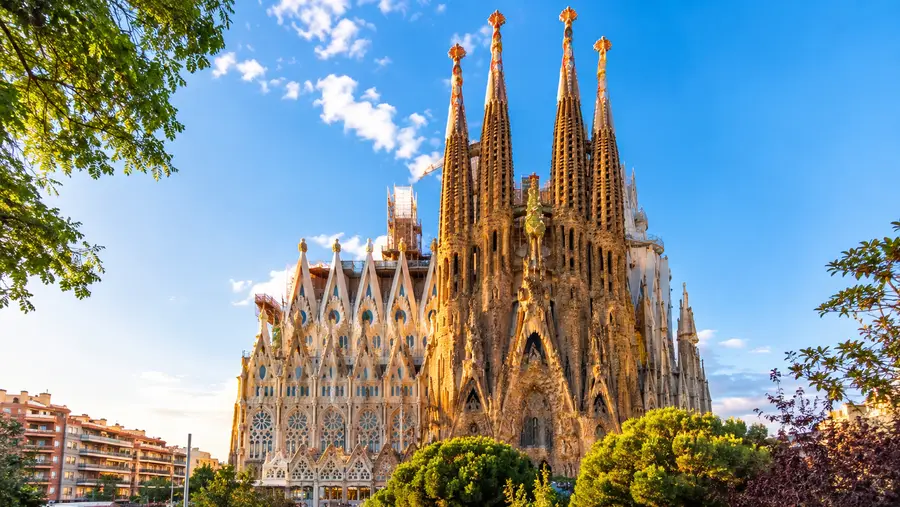
Start your walk on the corner of Carrer de Marina and Carrer de Mallorca. Grab an espresso at one of the small bakeries two blocks away, avoid the tourist trap cafes directly fronting the plaza, and take your time circling the city block counterclockwise. The sidewalk directly under the towers is usually so congested that you can barely tilt your head back without bumping into someone with a selfie stick. Back up across the street into the parks on either side. Plaça de Gaudí gives you the full Nativity reflection in the water. Plaça de la Sagrada Família on the west side provides park benches where you can sit under the shade of plane trees and study the Passion facade without straining your neck.
- Morning timing: Hit the Nativity facade between 8:30 AM and 10:30 AM for bright, warm front-lighting.
- Afternoon timing: View the Passion facade after 4:00 PM when the setting sun turns the pale stone orange and cuts deep geometric shadows across the carvings.
- Night walk: Return after 9:00 PM when the spotlights kick on; the shadows make Subirachs' statues look doubly haunting.
- Traffic avoidance: Walk the perimeter before 9:00 AM before the double-decker tourist buses start idling on Carrer de Marina.
Frequently Asked Questions about sagrada familia facades
Which Sagrada Familia facade was built first?
The Nativity facade was built first. Antoni Gaudí began work on its foundations in 1893 and devoted the rest of his life to it until his death in 1926, knowing it would establish the artistic standard for future generations.
Why do the Nativity and Passion facades look so completely different?
They represent opposite theological moments and were sculpted by different artists nearly a century apart. Gaudí created the organic, detailed Nativity side, while Josep Maria Subirachs designed the harsh, skeletal Passion side starting in 1987 to reflect grief and physical suffering.
What is the controversy surrounding the Glory facade?
The planned grand staircase for the Glory facade extends across Carrer de Mallorca, which would require the demolition of adjacent residential blocks and could displace roughly 1,000 apartments and local businesses.
What does the magic square on the Passion facade mean?
The four-by-four grid of numbers created by sculptor Subirachs always adds up to 33, whether counted horizontally, vertically, or diagonally. The number 33 represents the age of Jesus at his crucifixion.
Quick Reference
- Nativity Facade: East-facing, built 1893-1936, UNESCO World Heritage site
- Passion Facade: West-facing, sculpted by Subirachs, harsh angular lines
- Glory Facade: South-facing, current main construction zone, future main entrance
- Magic Square Sum: 33 (in 310 distinct mathematical combinations)
Book your sagrada familia experience:
My Take
If you only have thirty minutes, skip the selfie crowds under the Nativity porch and sit quietly on a bench across from the Passion facade in late afternoon. There is an uncomfortable, austere genius in Subirachs' cold figures that makes Gaudí’s surrounding stonework look alive by comparison. You come away realizing this building is not a dead museum piece frozen in time, but a stubborn, living argument made of rock.
Read more about sagrada familia.